
For decades, Student Information Systems have been the backbone of administrative processes in schools and universities all around the world. They store a wide array of data, from basic student information like names and addresses to more complex enrollment data and sophisticated attendance tracking. They also form the backbone of reporting out grades at the end of a term or year, as well as a wide variety of compliance reporting around everything from FERPA to CTE reporting. While these systems have always been fundamentally reliable, until recently, they have not been particularly intelligent. They have served as little more than a System of Record (SOR) storing data until it is needed by administrators or other authorized users.
The Fundamental Shift From System of Record to System of Intelligence
Ask any school administrator what their SIS does, and they'll describe a system of record - a digital filing cabinet that answers questions when prompted:
These are useful questions. But they're backward-looking. The administrator already knows something happened; the SIS just confirms it.
An AI-Powered Student Information System continuously analyzes all data within the information system, revealing patterns, revealing anomalies, and supporting administrators and teachers with questions that have not yet been thought of by them.
The distinction is meaningful.
A traditional SIS tells you what happened. An AI-enabled SIS goes one step further to help the administrator of the educational institution explain the reasons for events and even make predictions and offer suggestions for actions to be taken.
That’s not a feature. That’s not even an upgrade of a feature. It’s a fundamental change of the core of the tool that you are working with every day.
What Actually Makes an SIS "AI-Powered"?
Simply adding a chatbot interface to legacy SIS functionality is not sufficient to make a SIS “AI-Powered”. AI needs to be deeply embedded in the platform’s functionality and reporting, throughout all the systems’ early warning systems, and in the administrators’ work processes.
Here's what that looks like in practice.
Natural Language Search
Legacy SIS platforms require users to know how to use the system, to pull the correct report, apply the right filters, and even to know the correct menu to select. A few highly proficient power users can do this.
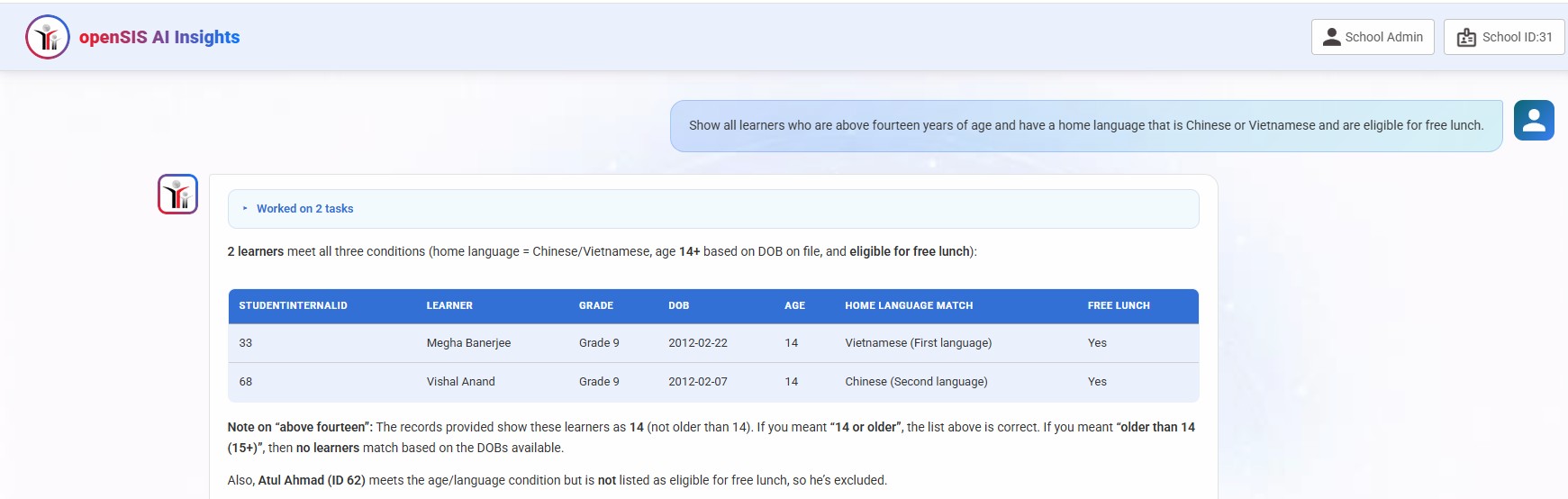
However, an AI-Powered SIS allows even the least tech-savvy user to ask simple questions about their institutional data and receive immediate, correct answers to their questions. Examples are:
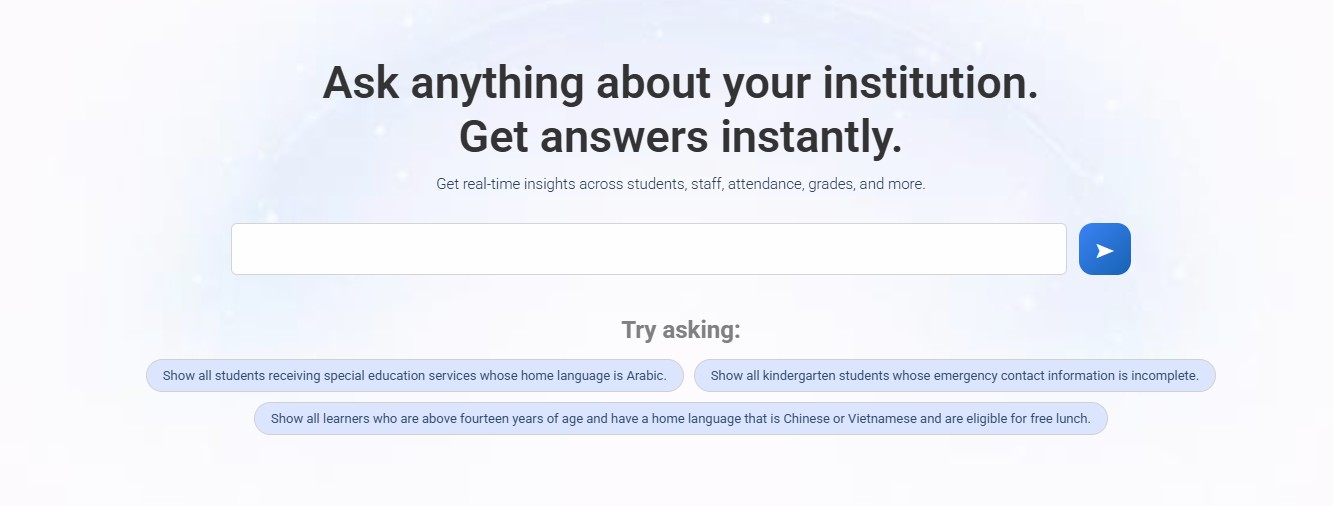
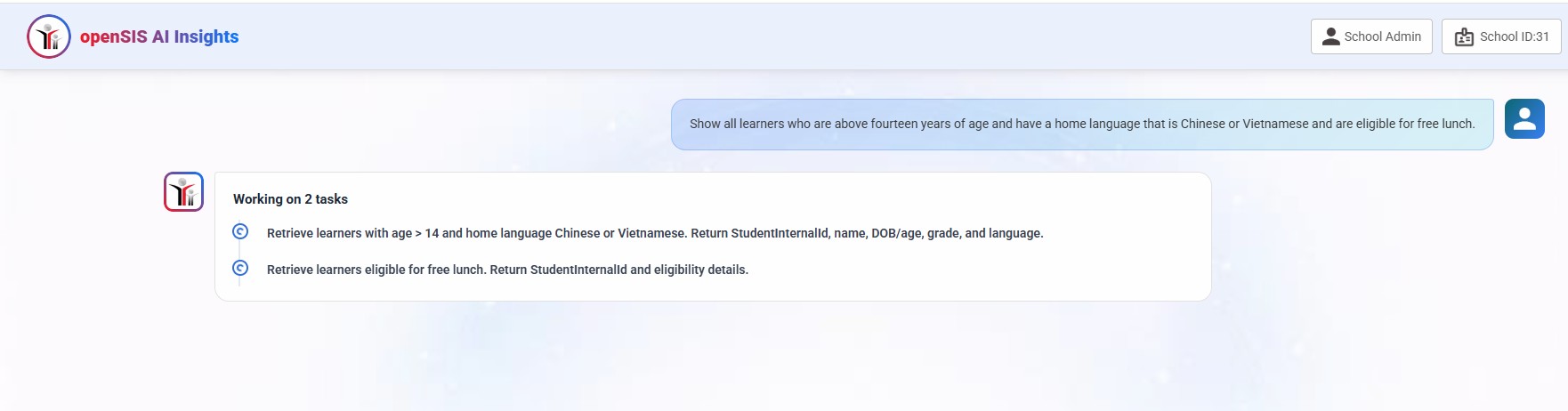
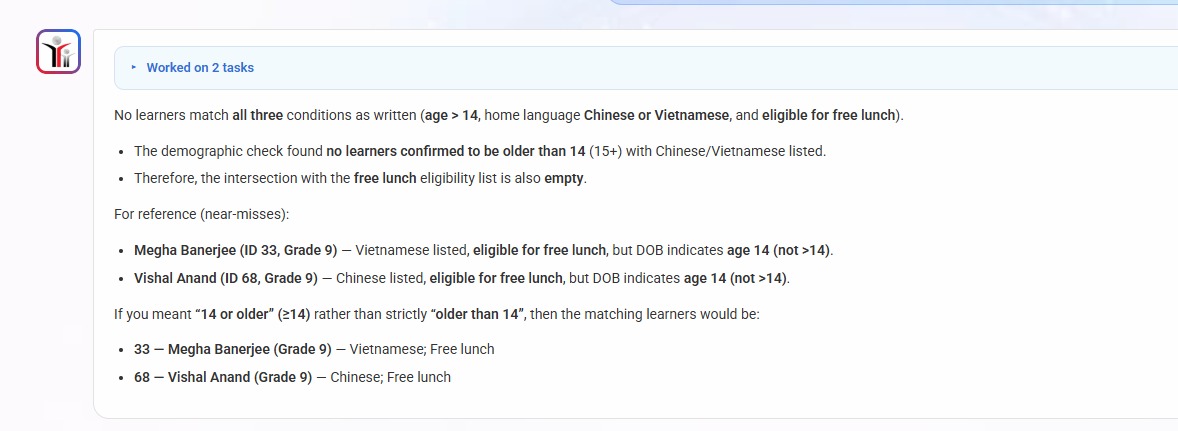
The system reads your intent, retrieves the data for you, and surfaces all the results you need in a snap to take action.
Predictive Analytics
Historical reporting has always been the SIS's bread and butter. AI pushes the horizon forward.
It’s not enough to simply predict something. You need enough time to react and intervene before it actually happens and becomes a crisis for your students.
Automated Insights
For the vast majority of institutions, they are swimming in a pool of data but starving for insight and answers from the information that already exists in their SIS database. Every morning, an administrator has to sift through dozens of reports and dozens of interactive dashboards in hopes of spotting a trend that requires immediate administrative action.
AI-Powered SIS will continuously scan through all of the data within your SIS and highlight what is important for your staff to see.
This is like having a tireless analyst watching all of your data for you and briefing you on the key things that you need to know.
AI-Native vs. AI-Added: A Critical Distinction
Not all SIS systems with enabled AI are created equal. Some have AI layered on top of the existing workflow and architecture, while others have been designed with intelligence as part of the core architecture from the ground up.
An AI native design rethinks and reimagines the core workflow of SIS. Thus, such a workflow will look something like: ask a question → get an understanding → receive an analysis → review recommendations → take action.
Note how this workflow is conversational in nature and how the core intelligence of AI is not an added feature or module, but the core architecture itself.
When evaluating new technologies or planning a technology overhaul, the architecture of AI-Powered SIS platforms should be a consideration for all schools and universities. In the long run, AI-native systems will continue to grow in value as more and more data is contributed by the institution and incorporated into the system’s ‘understanding’ of things.
The Real Institutional Benefits
What do you get from an AI-Powered SIS for a school or university?
- Fewer administrative hours spent generating reports, answering data-requests and compilation of data. More time for teachers and staff to support students, develop a strategic vision, and enhance teaching.
- Enable Faster Decisions with Real-Time Insights. Schools can quickly respond to emerging issues such as declining grades, or new trends in enrollment patterns. Administrators can make better decisions, based on the most up to date data, and reallocate resources to improve programs and services.
- Early intervention for at-risk students. Identifying a risk factor early on in a student’s time at an educational institution allows for more options to address the issue before it becomes a crisis that requires intervention just before a student leaves the institution. AI can identify a risk factor for a student before it becomes a problem and the school can then do something to support that student.
- Better return on existing data: All educational institutions have a vast amount of data collected and stored within their systems over the years. Without the proper tools, this data is often never fully utilized. By leveraging the power of AI within your student information system, all of that existing data becomes a continuous source of valuable institutional intelligence. What would typically take months to uncover through manual analysis is provided on an ongoing basis, giving your leaders and decision-makers the information they need to make the best decisions for students and their schools.
A Practical Question for Every Institution
The relevant question for educational institutions today isn't whether AI will transform student information systems. That transformation is already underway. The relevant question is: when do you want to be part of it?
Early adopters are building competitive advantages right now - faster administrative cycles, stronger student retention, more efficient operations, and better-informed leadership decisions. Institutions that delay will find themselves operating legacy workflows in an environment that increasingly expects AI-native capabilities.
The Student Information System was once evaluated on how well it stored data. The next generation will be evaluated on how well it turns data into action.
For institutions serious about improving student outcomes and operational efficiency, that standard is already here.