Connecting Systems for Seamless Online Learning
Seamless LMS Integrations
(Currently available for Moodle, Canvas and Google Classroom)
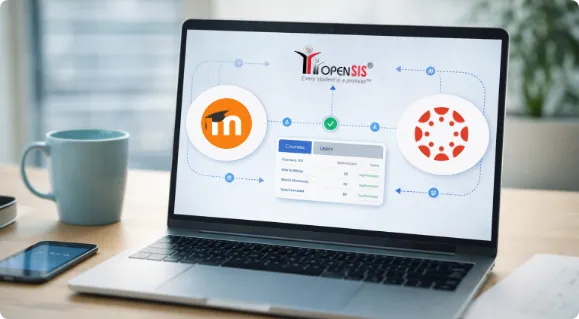
Virtual institutions rely heavily on Learning Management Systems for course delivery. openSIS integrates with platforms such as Moodle and Canvas to support single sign-on and synchronized user and course data.
This integration reduces duplication, improves data accuracy, and creates a smoother experience for students and staff.
This integration reduces duplication, improves data accuracy, and creates a smoother experience for students and staff.
Bi-Directional Integration
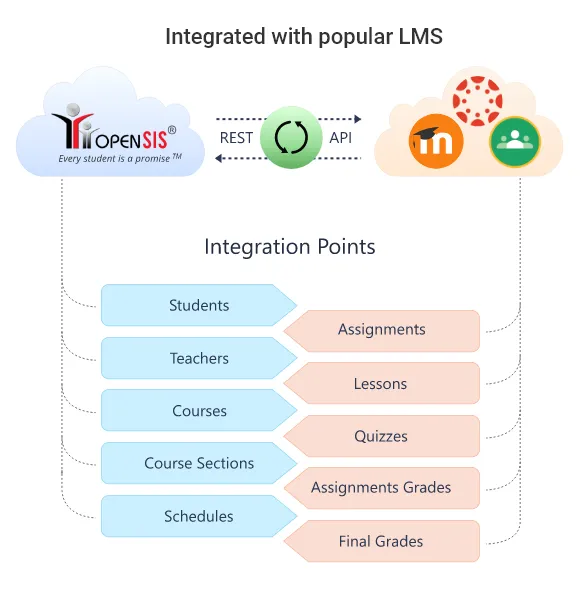
The two applications are integrated in the following areas:
When a new student, teacher, or staff is created in openSIS, they are automatically created in the LMS. For existing users, there is a check box option and when it is checked, the user gets created in the LMS.
openSIS courses are divided into three levels. Subject, Course, and Course Section, and when a course section is created as a virtual class it automatically creates the header record of the course section in the LMS. Teachers or administrators have to populate the course with the content from a zip file or a SCORM package.
In openSIS, when students are scheduled in a course section that also exists in the LMS, all students are automatically synchronized in the LMS with proper authentication. Students get access to that class and all its contents. The teacher who is teaching the class gets to see all those students enrolled in the LMS course. The system even creates the calendar weeks in the LMS based on the beginning and end dates of the marking period (in openSIS) in which the course period is offered.
When a Course Section is created in openSIS with the option to create in the LMS, a default Assignment category called Moodle, Canvas or GCR is created within the openSIS Grade book This category synchronizes Teacher activities from the LMS in the form of Assignments, Lessons, and Quizzes. All grades given in the LMS can be pulled into openSIS.
When a new student, teacher, or staff is created in openSIS, they are automatically created in the LMS. For existing users, there is a check box option and when it is checked, the user gets created in the LMS.
openSIS courses are divided into three levels. Subject, Course, and Course Section, and when a course section is created as a virtual class it automatically creates the header record of the course section in the LMS. Teachers or administrators have to populate the course with the content from a zip file or a SCORM package.
In openSIS, when students are scheduled in a course section that also exists in the LMS, all students are automatically synchronized in the LMS with proper authentication. Students get access to that class and all its contents. The teacher who is teaching the class gets to see all those students enrolled in the LMS course. The system even creates the calendar weeks in the LMS based on the beginning and end dates of the marking period (in openSIS) in which the course period is offered.
When a Course Section is created in openSIS with the option to create in the LMS, a default Assignment category called Moodle, Canvas or GCR is created within the openSIS Grade book This category synchronizes Teacher activities from the LMS in the form of Assignments, Lessons, and Quizzes. All grades given in the LMS can be pulled into openSIS.

Improve Engagement and Performance Visibility
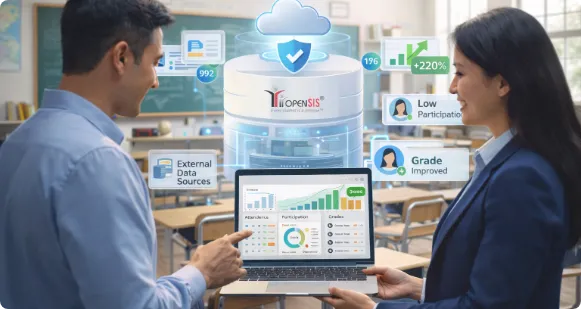
openSIS allows institutions to monitor attendance, participation, and academic performance across virtual programs.
This visibility supports instructors and administrators in identifying engagement trends and addressing concerns early in the learning process.
This visibility supports instructors and administrators in identifying engagement trends and addressing concerns early in the learning process.
Scale Virtual Programs with Confidence
As online enrollments grow, systems must scale without added complexity. openSIS is built on a cloud-based architecture that supports expanding student populations and program offerings.
Institutions can grow their virtual education initiatives while maintaining system reliability and performance.
Institutions can grow their virtual education initiatives while maintaining system reliability and performance.
Trusted by Online Learning Institutions

Power Your Virtual Education Programs withopenSIS
Discover how openSIS supports virtual learning while simplifying student management.